


It is often challenging to pin down the factors guiding Donald Trump a month into the American and Israeli campaign of military action on Iran.
But it is clear he has his attention fixed on the oil markets.
A word – or social media post – from the American leader about his strategies once would spark big swings in oil prices, as traders reacted to indications the hostilities could escalate or conclude.
But in recent days, market players are showing signs of becoming increasingly doubtful about the impact of his remarks.
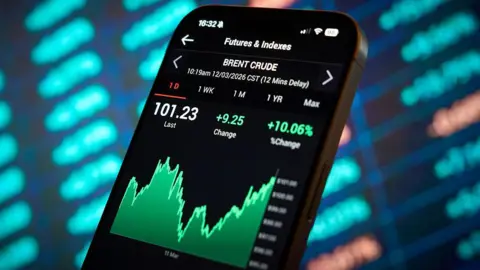
Oil was hovering around around $72 a barrel (bbl) prior to 28 February, when the strikes on Iran started.
Last week, it peaked at $118 a barrel on 19 March and by Friday afternoon was sitting at just below $112 – markedly up from its pre-conflict price.
The following are several examples from the recent weeks where Trump and the financial markets appear to have influenced one another – with mixed impacts.
Navigate with the arrow to proceed to the next slide.
"Energy prices have acted as a barometer for wider political and financial risks, surging when Trump's language becomes hawkish and declining when his rhetoric becomes more conciliatory," says one investment manager.
He adds that financial markets are understandably sensitive to those messages, given the substantial macroeconomic threats that are associated with increasing oil prices.
"Traders are trying to price real risk," he comments. "Markets can seem nervous or bewildered, but what they're actually attempting is managing event risk in real time, with oil acting as the centre of that."
However, it can be tough for traders to decide how to trade, especially since a portion of Trump's remarks appear aimed at influencing oil prices, instead of conveying policy, says another financial strategist.
"As the saying goes, the first casualty of conflict is truth," he says. "My belief is much of the dialogue back-and-forth around successful negotiations, and the contrary, very much are centred around simply shifting the market price of oil."
Market Reactions Grow More Muted
On a recent Thursday, moments after US equity markets recorded their biggest drop since the beginning of the conflict with Iran, Trump announced talks with Iran were going "extremely well" and he was putting off military strikes on Iran's energy infrastructure until at least 6 April.
However, the oil price continued to climb.
One market analyst points out that market reactions are "showing less volatility" because of the "huge gap" between Trump's reassurances and the lack of response from Tehran.
"Given the appearances, a large number of investors can not see an early conclusion to the hostilities and financial markets continue to be anxious."
Another investment director notes markets have also become accustomed to Trump "frequently altering course at hints of geopolitical, equity market or financial stress".
"We are seeing a level of wariness, or even frank cynicism, creeping in at the margins," he concludes.


